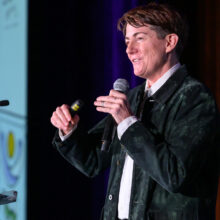
Cas Holman (Credit: Emerald/EFA Conference + Expo)
Play is an intergenerational force that can bring together 8-year-olds and 80-year-olds and can benefit each generation differently, according to Cas Holman, author, designer, and toy company founder.
Kicking off the 2026 Environments for Aging Conference + Expo with an opening keynote session on Tuesday, March 18, titled “The Power of Play: How We Can Use Curiosity to Change the World,” Holman said that despite common misperceptions, play is often “the most productive” thing people can do.
“Go back to work and be more creative,” she advised the conference attendees. “However, I want people to play because it’s a part of who we are. It helps you reconnect with who you are, to remember who you are, and maybe even evolve who you are, as we did in childhood.”
Holman is the founder of Heroes Will Rise (Hope, R.I.), an independent toy company focusing on open-ended play and creativity through innovative design, and the author of Playful: How Play Shifts Our Thinking, Inspires Connection, and Sparks Creativity. Her career crosses into design, having formerly served as an associate professor of industrial design at the Rhode Island School of Design (Providence, R.I.).

During her keynote session, she highlighted several projects that introduced concepts of open play in environments where traditionally that type of activity might have been dissuaded. For example, the Queens Museum in New York City hired Holman to design a space that engages children and families.
“The Queens Museum is an art institution. It has giant gestures of white, clean space, hard cold floors, and they said, ‘kids don’t always feel welcome here,’” she explained. “They’re not supposed to touch anything or run; there are a lot of rules here. So, we tried to bring play into the museum as a way of making it more human.”
The installation featured structures for climbing and mark-making with abstract, awkwardly shaped crayons. “And we found that actually adults also played in this often. When I design things for children and they’re in children’s museums, adults will support the child’s play,” she said. “But I’m also thinking about intergenerational play … and in this case, the adults at times did join in and play on their own.”
The challenge with adults, she said, is that play often becomes very structured, as with sports, with defined goals of “winning,” but open, free play also has value.
“We could bring together the greatest minds and design an adult playground, and I don’t know if it would necessarily work, because the problem isn’t that the slide isn’t steep enough. The problem is us. We have to let ourselves play,” she said.
In play, she emphasized, there are no right answers. “It’s not about being good or bad at something. It’s about enjoying it and being engaged in it.”
Holman concluded her keynote session with her thoughts on the future of learning, which she said is rooted in play. “Increasingly, we’re having a very hard time understanding each other … and play is the absolute best way to do that. In play, we can learn about each other and understand each other in ways that would otherwise not be possible,” she said.
Check out the latest news, updates and all you need to know for the 2026 EFA Conference + Expo here.