As people age, the question isn’t simply where they’ll live, but how they’ll live.
According to the U.S. Department of Health and Human Services, about 1 in 4 older adults experience social isolation, a condition increasingly linked to poorer physical health, cognitive decline and reduced overall well-being.
That reality underscores the role housing can play in reducing isolation.
In New York City, where roughly 1.55 million residents are age 62 or older, housing providers are grappling with both the scale and complexity of an aging population. A 2024 report from the New York City Department of Housing Preservation and Development found that seniors now represent nearly one-fifth of the city’s population, a demographic shift that requires renewed focus.

In the Bronx, Fischer Senior Apartments in the Bronx, N.Y., was conceived against that backdrop. Designed by Shakespeare Gordon Studio (SGS), the development combines affordable housing with a supportive design strategy tailored to seniors.
Now in its final stages of construction, Fischer Senior Apartments is expected to begin welcoming residents in mid-2026. Designed for the West Side Federation for Senior and Supportive Housing (WSFSSH), the nine-story building will provide 105 affordable apartments for residents 55 and older earning less than half of the area’s median income, including 54 units reserved for formerly homeless individuals.
“The measure of our worth as a society is how we treat our most vulnerable,” said WSFSSH Executive Director Paul Freitag, as reported by the Bronx Times. “As the senior population in the city grows, we have an obligation to deliver good quality housing that meets their needs and enables them to live healthy, engaged, rewarding lives.”
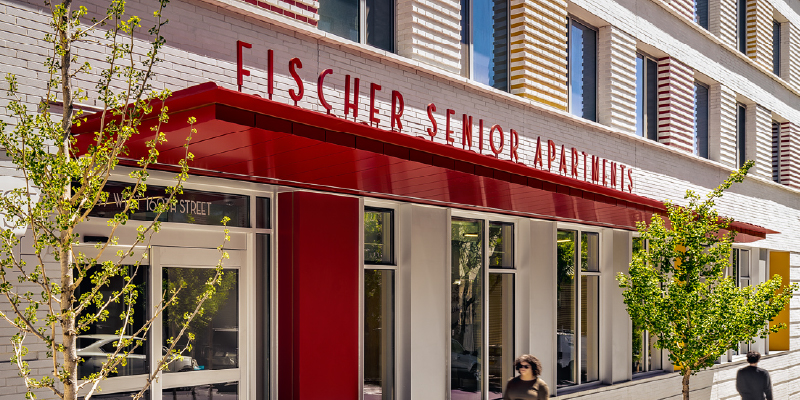
Image is courtesy of Alexander Severin Architectural Photography
A model between independence and care
Two upper floors are dedicated to what WSFSSH describes as a “cluster care” model. Studio apartments are arranged around shared lounges and outdoor terrace spaces, while on-site staff assist with meals, wellness monitoring and daily activities.
Outdoor areas and access to daylight help shape the building’s layout, extending daily life beyond individual apartments.
SGS notes, “Common spaces are especially important in senior living where residents may not have the traditional support structure of family or friends. To encourage engagement, we distributed a variety of communal spaces throughout the building, from the expansive first-floor lobby to the flexible community room and patio at the rear.”
Building on a challenging site
The architecture was shaped in part by a steep, city-owned parcel that had remained undeveloped for decades. Instead of overriding the site’s topography and prominent rock outcropping, the design worked with it.
The street-facing façade draws particularly from the sleek lines, detailed brickwork and bright colors typical of the Bronx’s art deco structures. The façade features light-gray concrete brick punctuated by large windows and elegant brick corbeling, with distinctive patterns of glazed brick in yellow, red and blue. For SGS, “This approach adds texture and visual depth to the otherwise flat wall and matches the color palette of neighboring buildings.”
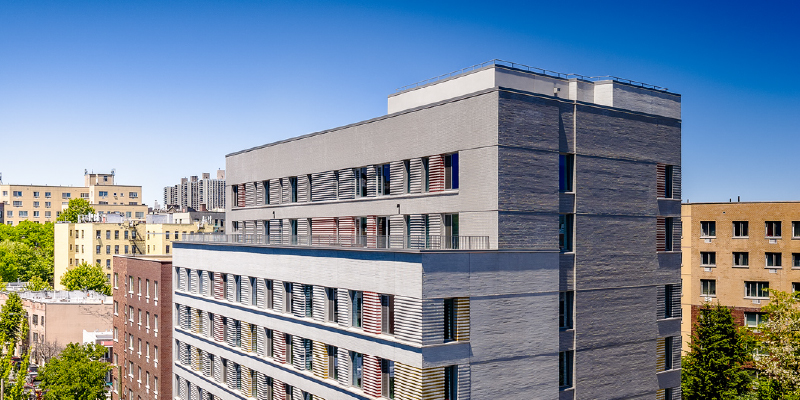
Image is courtesy of Alexander Severin Architectural Photography
Durability, stewardship, and long-term performance
The project incorporates approximately 151,000 concrete brick units manufactured with ground glass pozzolan, a recycled, supplementary cementitious material used to replace 30 percent of the cement content across the masonry package.
According to Glenwood Masonry Supply, the approach diverted the equivalent of 102,000 glass bottles from the landfill while helping reduce embodied carbon without compromising durability or architectural quality.
For residents arriving in 2026, success may be measured less by the building itself than by what it makes possible: independence without isolation and the ability to remain part of the community they call home.
For teams navigating the demands of senior living environments, early technical support can help clarify system-level decisions.
The Block Design Collective provides design assistance to evaluate how concrete masonry systems support durability, safety and long-term resilience. The BDC offers guidance on material efficiency, code compliance and constructability, with services provided in-kind and without obligation.
Contact [email protected] or visit blockdesign.org.